
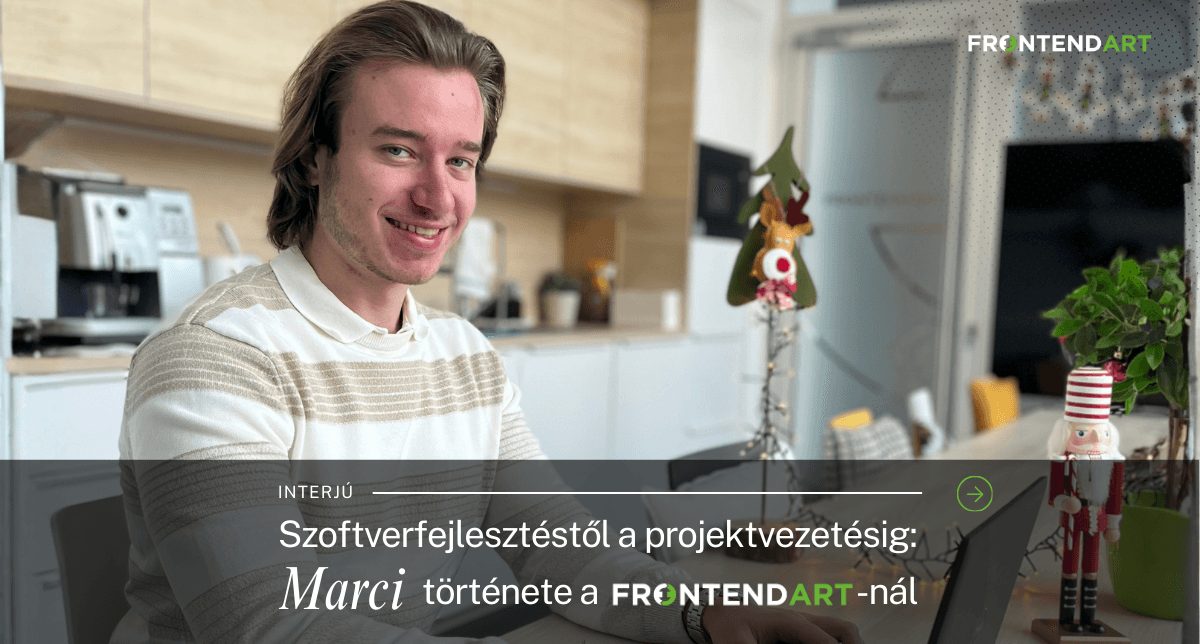
Some career paths are not shaped by a pre-written plan but by curiosity and the desire to grow. Marci began his career at FrontEndART as a software developer and climbed the ranks step by step. Today, he works as a project manager, supporting teams, coordinating client projects, and helping ensure that every development is implemented in the best possible way.
In the interview, he shared how he first got involved in the world of IT, why he decided to join us, and when he first felt the desire to move into a leadership role. He spoke honestly about the challenges of the transition, why continuous development is important to him, and what he appreciates most about the environment he currently works in.
How did you first get involved in the world of IT?
M: “I was interested in the world of IT from a young age, so I gained my first experiences through self-study and small-scale development projects. Later, this interest took a more conscious direction, and through my studies and practical work, it became clear that I wanted to build a long-term career in the IT field.” – Marci responded.
How did you discover FrontEndART, and why did you decide to join?
M: “I discovered FrontEndART through professional recommendations and online job ads. The company’s approach and the opportunities for growth were convincing from the very first impression, so I felt that this was the place for me. After my internship, there was no question about staying—the office atmosphere and the development opportunities offered by the company immediately won me over.” – Marci added.
When did you first feel the desire to move into project management?
M: “My interest in project management developed after having 3-4 years of experience as a developer. At that point, I felt my professional growth had started to slow down, and I had the chance to try out some project management tasks on smaller projects, which confirmed my desire to move in that direction.”
What was the biggest challenge during your transition?
M: “The biggest challenge during the transition from developer to project manager was the increased responsibility and the simultaneous loss of control.” – said Marci, and added: “As a project manager, I'm directly responsible for meeting deadlines and managing delays, while my daily routine is less under my control since meetings and coordination tasks largely dictate the workflow.”
What does an average day look like for you as a project manager at FrontEndART?
M: “My typical workday starts with daily meetings, where I review the teams’ progress on assigned tasks. After that, I assess the current status and risks of the projects and examine how well deadlines are being met compared to the original plans.” – he answered, then emphasized: “Afternoons are usually filled with client meetings, and I focus on administrative tasks during the remaining time.”
What do you like most about this position?
Marci highlighted the variety and ever-changing nature of the role: “What I value most about being a project manager is the diversity. Since no two developers or clients are the same, each meeting brings different situations and challenges that constantly require new solutions.”
What advice would you give to someone starting their career in development who might want to follow a similar path?
M: “For those preparing for a similar career, I recommend starting with smaller, less critical projects where the level of responsibility is more manageable, allowing a smoother transition into the role.” He emphasized: “Patience is especially important—both in communication with clients and in developing project management skills—but I believe it’s definitely worth the effort.”
Marci’s career path clearly demonstrates how one can gradually transition from a development background to project management at FrontEndART. His story shows that progress doesn’t happen overnight—it takes experience, openness, and conscious decisions to climb the career ladder. The project management role brings new challenges and responsibilities but also offers the opportunity to gain a broader perspective on teamwork and client project operations. This journey can serve as a good example for those who, in the long term, are interested not only in technical work but also in organizational and leadership tasks.